
Toxicology comprises translational science that addresses risks to public health and the environment posed by chemical substances. While toxicology has historically focused on studying the risks of adverse effects due to chemical stressors, this field has evolved to more broadly encompass the study of other risks posed by exposures to non-chemical stressors. Types of non-chemical stressors may include, but are not limited to, physical, social, and biological types that may or may not involve a cumulative nature.
-
William Klaren discussed the influence of non-chemical stressors on chemical-biological interactions in a presentation titled “Targeted State of the Science Scoping Review for Incorporating Stress Within Experimental Models of Chemical Toxicity.” The presentation focused on considering non-chemical stress, such as animal handling, in experiments and how this may translate to the susceptibility to adverse effects in risk assessments.
-
In a presentation titled “Equity in Toxicity: Unmasking the Hidden Impact of Stress on Chemical Toxicity in Environmental Justice Communities,” Laura Word deliberated on in vitro and in vivo approaches to studying communities that have been shown to display elevated susceptibility to chemical toxicity due to higher stress levels.
-
Maheedhar Kodali presented on the topic of studying a US FDA–approved medication, cannabidiol, and use of its anti-inflammatory and antioxidant properties to address stress, such as cognitive and mood dysfunction and chronic pain, in a presentation titled “Cannabidiol Treatment in a Mouse Model of Chronic GWI Modulates the Transcriptome of Microglia, Impacting Pathways Associated with Neuroinflammation, mTOR Signaling, and Autophagy.”
-
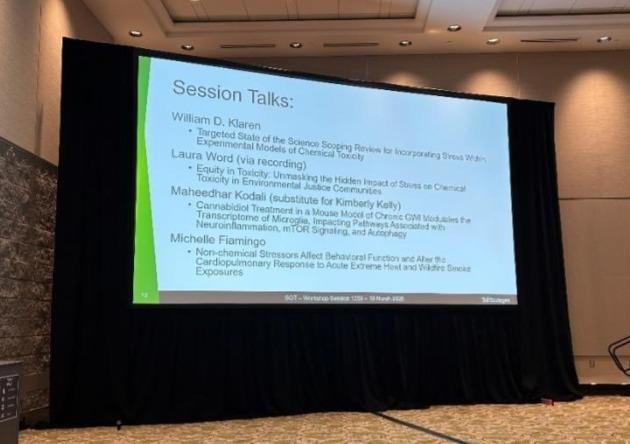
Michelle Fiamingo considered how stress, such as depleted housing and heat due to wildfires, may modify susceptibility to chemical stressors and the development and advancement of underlying disease in a presentation titled “Non-chemical Stressors Affect Behavioral Function and Alter the Cardiopulmonary Response to Acute Extreme Heat and Wildfire Smoke Exposures.”
Multiple approaches to studying stress in research were discussed and recommended for consideration in experimental models to address this important research gap. There is currently a need to better understand how stress can affect vulnerability to chemical and non-chemical factors and how this may translate to future initiatives for better public health and environmental protection and promotion.
This blog reports on the Workshop Session titled “Incorporating Stress as a Variable into Toxicological Testing: Advancing Our Understanding of Cumulative Impacts” that was held during the 2025 SOT Annual Meeting and ToxExpo. An on-demand recording of this session is available for meeting registrants on the SOT Online Planner and SOT Event App.
This blog was prepared by an SOT Reporter and represents the views of the author. SOT Reporters are SOT members who volunteer to write about sessions and events in which they participate during the SOT Annual Meeting and ToxExpo. SOT does not propose or endorse any position by posting this article. If you are interested in participating in the SOT Reporter program in the future, please email SOT Headquarters.
#SOTReporter