“To cope with the unprecedented situation, the research laboratories at University of Kansas Medical Center main campus will go into hibernation starting Wednesday March 18th, 2020. Further, an institution-wide hiring freeze is being instituted.” The email flashed on the computer and my heart sank. With the COVID-19 pandemic raging all around us, life had already become very unpredictable. The in-person SOT Annual Meeting, a constant in otherwise changing life, had been canceled, and so were many other things. Meetings, weddings, vacations. My colleagues and I were scrambling to figure out our online lecturing schedules. Everybody was worried. Everybody was scared. A lockdown had been implemented. In that stressful time, when nobody knew what the future held, an in-person summer program for undergraduate students seemed like a dream fast fading away.
The Department of Pharmacology, Toxicology and Therapeutics at University of Kansas Medical Center (KUMC), where I work, has hosted a Summer Undergraduate Research Fellowship (SURF) program for over 20 years. It is one of the most successful summer programs by any standards. The majority of our summer students go on to graduate school, and many come back to our department to pursue PhD in toxicology. When I took over the program as its director, my first act was to seek funding from SOT, which we had been very successful at obtaining. Like the previous three years, we had secured funding for the SURF2020 program. Like each year, we had received over 20 great applications. And like every year, we had selected a slate of six outstanding applicants to start a 10-week, highly research-intense summer program at the end of May 2020. Then the pandemic began, and all that hard work and those aspirations and learning opportunities suddenly seemed to vanish.
I decided to try anyway. I received enthusiastic support from Dr. Hartmut Jaeschke, my department chair, and my colleagues who were taking a summer student in their labs. The directives coming from the upper administration to the department were changing daily. It wasn’t anybody’s fault; those were confusing and chaotic times. The first hurdle was to get these students hired as summer students during a newly instituted hiring freeze so they can be paid their stipend. Fortunately, anyone hired on external funding, such as a National Institutes of Health grant or SOT summer grant, could be hired, but only after a substantial amount of paperwork. While we were figuring out the details, I started receiving emails from anxious students about their applications and whether we were going to continue the program. I was cautiously optimistic and asked the students to plan to be on the campus during the summer. By mid-April, it was clear that we could hire the summer students.
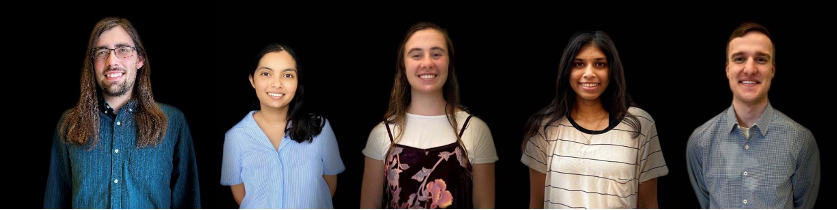
The interns included (left to right) Darren Boydston, Nicole, D’Souza, Madeline Hlobik, Simran Mahabeshwarkar, and Matthew Jaeschke.
It also became clear that the lab hibernation would end in mid-May and we could go back to the campus. However, it also was evident that we would have to substantially alter the daily activities of the students based on the new COVID restrictions. “Masks” and “social distancing” became the buzz words. Only certain number of people were allowed in a laboratory at a time. We had to figure out seating and working arrangements according to social distancing norms. And most unfortunately, we had to forgo all “fun” activities, such as a baseball game with current graduate students, an invitation to the departmental picnic, a welcome lunch, and a farewell program. But everybody—the summer students and the mentors and graduate students who interacted with the undergrads and trained them on daily basis—was still happy that we could host the program even with all those restrictions. Somehow, it gave a sense of normalcy in a time when everything else was changing fast.
In the end, we had a very successful summer program. Six undergraduate students, all local to the Kansas City area attending various universities around the United States, conducted in-person research in six different laboratories. They learned basic research techniques, conducted experiments, wrote an abstract on their work, and presented their findings during a virtual presentation ceremony attended by, among others, the SOT Faculty United for Toxicology Undergraduate Recruitment and Education (FUTURE) Committee representatives. During the 10-week program, interns had virtual discussions with current graduate students and the departmental faculty about career choices, graduate school life, diverse research areas, and toxicology and liver pathobiology. Almost all our SURF students were new to toxicology. They left the program with a renewed sense of what it is like to do research for living and why toxicology is one of the farthest-reaching interdisciplinary subjects in biomedical sciences. I am confident that we will hear back from them again, in the future, as aspiring graduate students.
The year 2020 will be remembered for a long time and for many reasons. But for us here at KUMC, one of them will be for the way that everybody—SOT administrators; KMUC mentors, department leaders, and administrators; graduate students; and the summer students—worked together to make the SURF program possible during a pandemic. I owe them a big thank you!
This blog is one of a series highlighting undergraduate intern research activities that were supported by SOT with funds administered by the Faculty United for Toxicology Undergraduate Recruitment and Education (FUTURE) Committee. Internship hosts can apply for matching funding for up to one-half of the cost for a summer undergraduate research position. The application deadline for next year is January 8. Relevant intern positions are listed on the SOT “Internship Resources web page,” whether or not they receive SOT support. Please send internship opportunity information to SOT Headquarters.
#2021Awards#Undergraduateeducation#EducationandCareerDevelopment